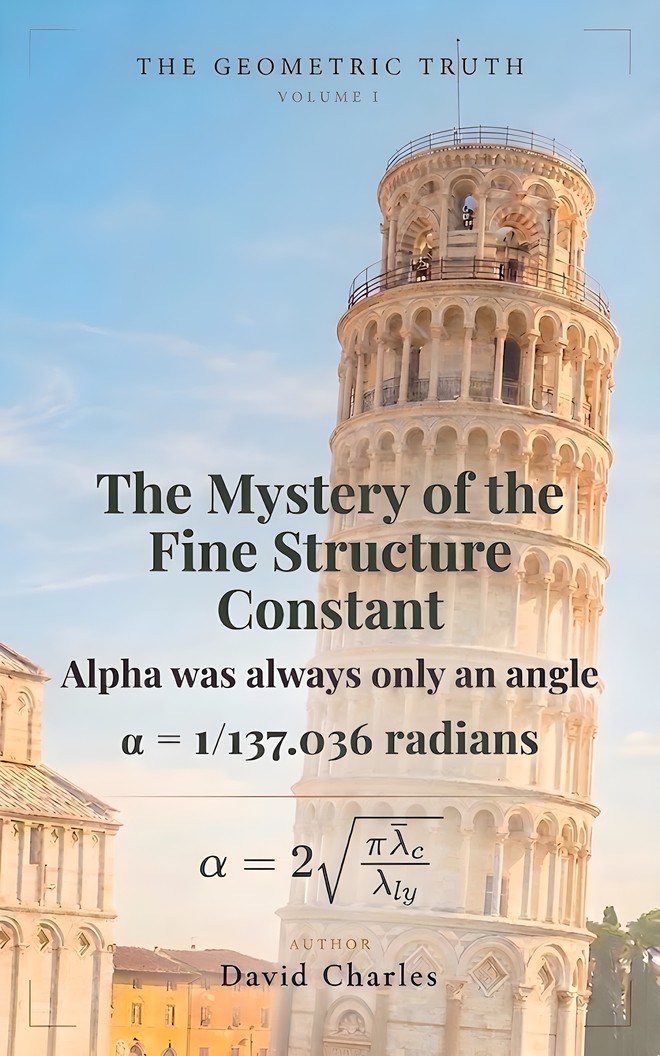
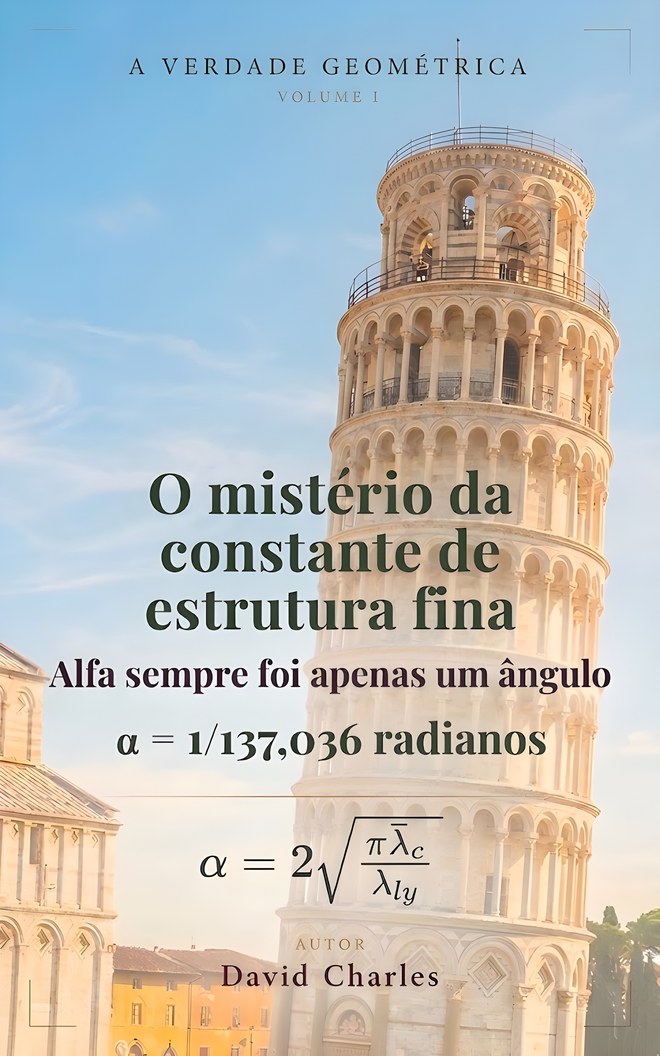
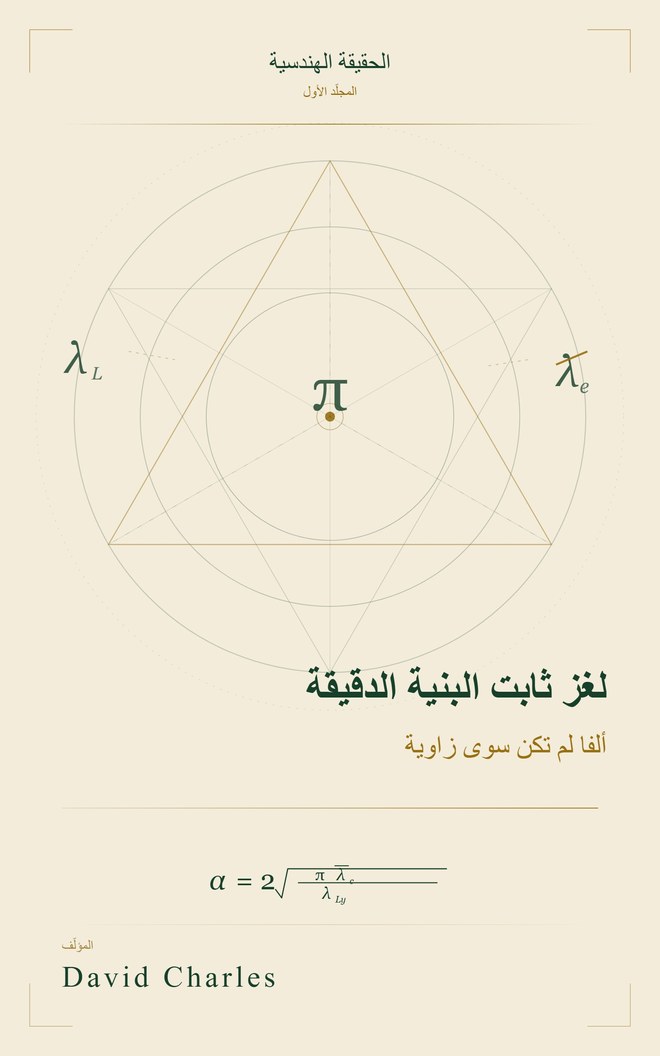
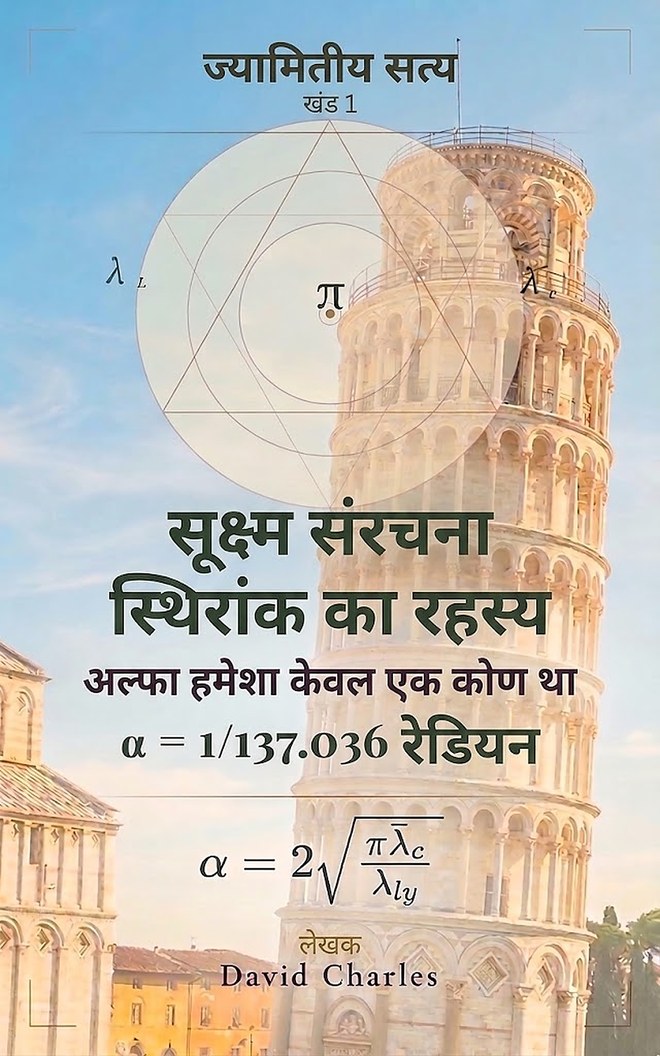
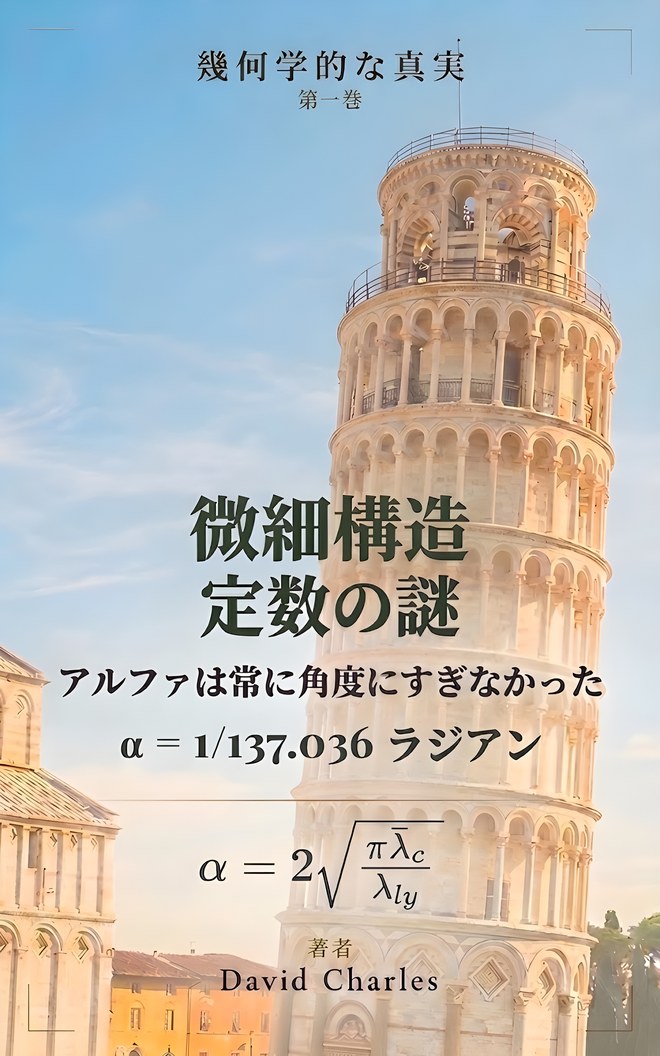
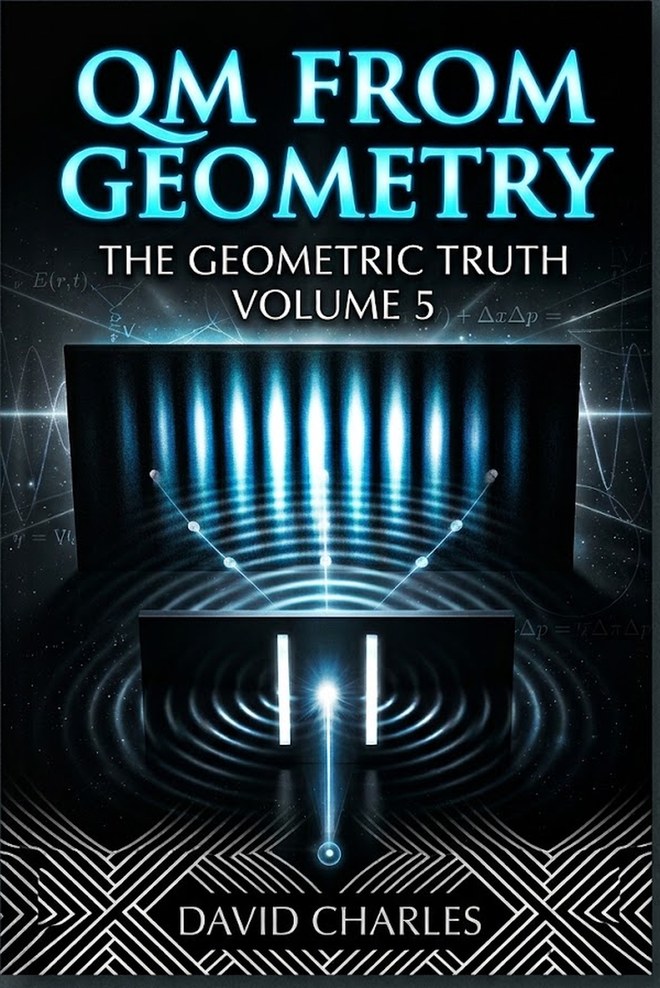
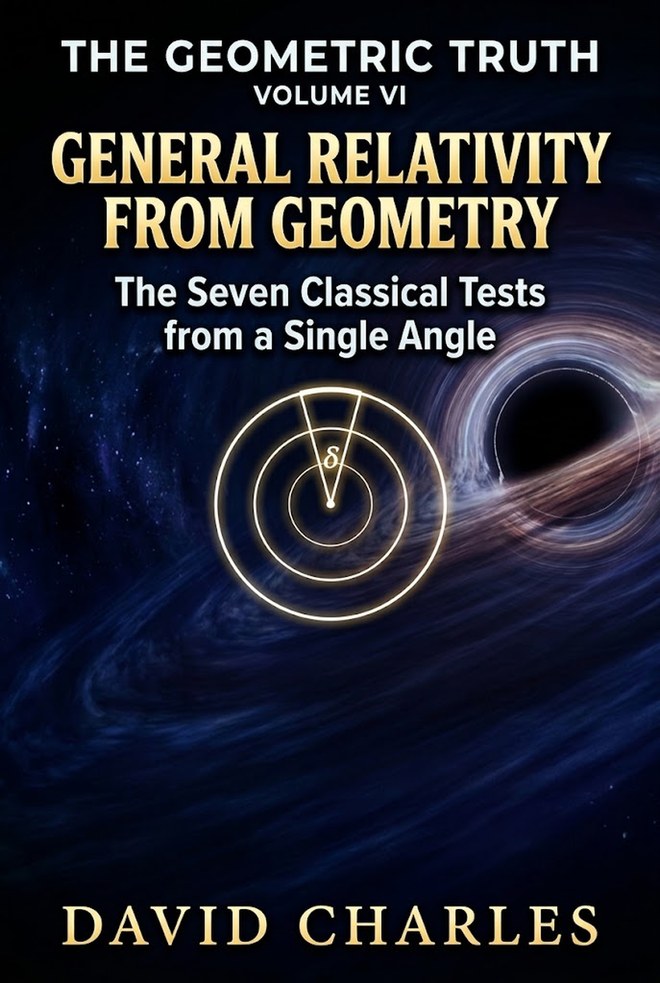
The constants of nature are not accidents. The speed of light, Planck’s constant, the fine structure constant: they are geometry, and a single hydrogen atom authors them all.
Six volumes. Ten languages. Nothing asserted — everything derived, and checkable in minutes.
One Claim, Carried Through All of Physics
The numbers were neverfree to be otherwise.
Modern physics treats its constants as brute facts — dials set by no one, measured to twelve decimal places and explained by nothing. The Geometric Truth argues the opposite.
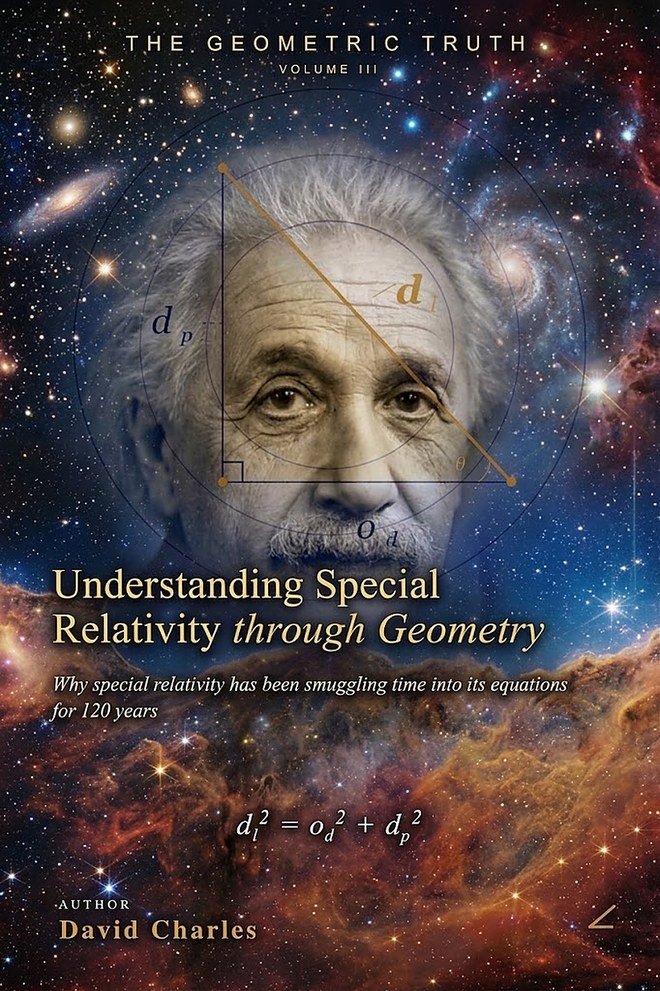
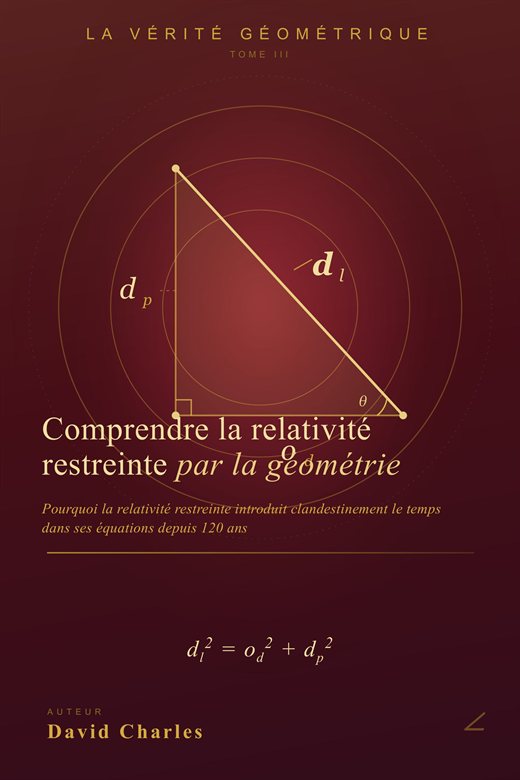
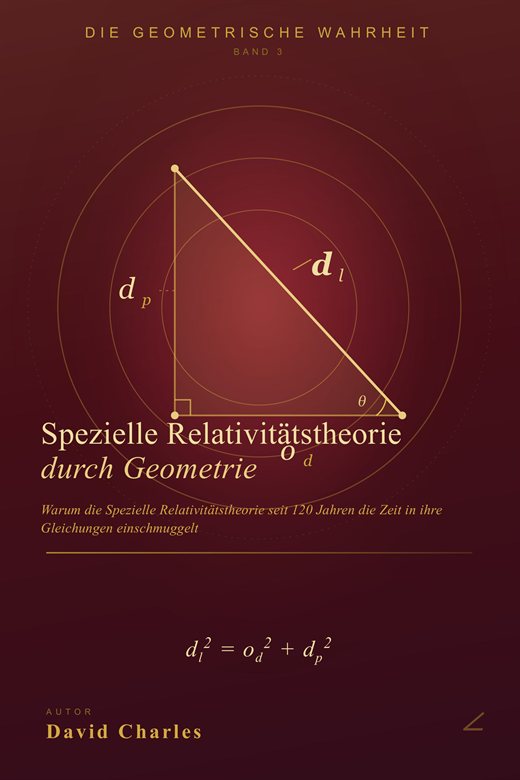
Take the oldest thought experiment in relativity: a clock made of light bouncing between two mirrors. Watch it from a moving platform and the light traces the hypotenuse of a triangle — its base the platform's motion, its height the resting light path.
Everything usually presented as paradox — moving clocks running slow, the factor γ, the impossibility of exceeding c — is already present in that one triangle, waiting to be read off. No postulates accepted on authority; a drawing, and the courage to take it literally.
Where physics says measured, ask whether geometry says necessary.
Watch
See it derived.
Short films that build the results on screen — no jargon, just geometry.
The films show the result. The books show every step — derived, in full.
Stay in the Loop
Hear when the next volume lands.
New volumes, new translations, and occasional notes on the work in progress — including The Fall. No noise, ever.
The Theory
Physics has itthe wrong way round.
Physics treats the fundamental constants as inputs — numbers imported into the equations and never explained. They are outputs. The geometry of a single hydrogen atom produces them; nothing is put in by hand.
The Inversion
The atom authors the constants.
For a century, theoretical physics has treated the fundamental constants — the speed of light, Planck’s constant, the fine structure constant — as bedrock: independent numbers, measured to exquisite precision, handed to the equations and never explained. Everything else is built on top of them.
This work turns that around. Those constants are neither independent nor fundamental. Each one is authored by a single object — the hydrogen atom. Its geometry makes the speed of light. Its geometry makes Planck’s constant. The fine structure constant is simply an angle expressed in radians inside it.
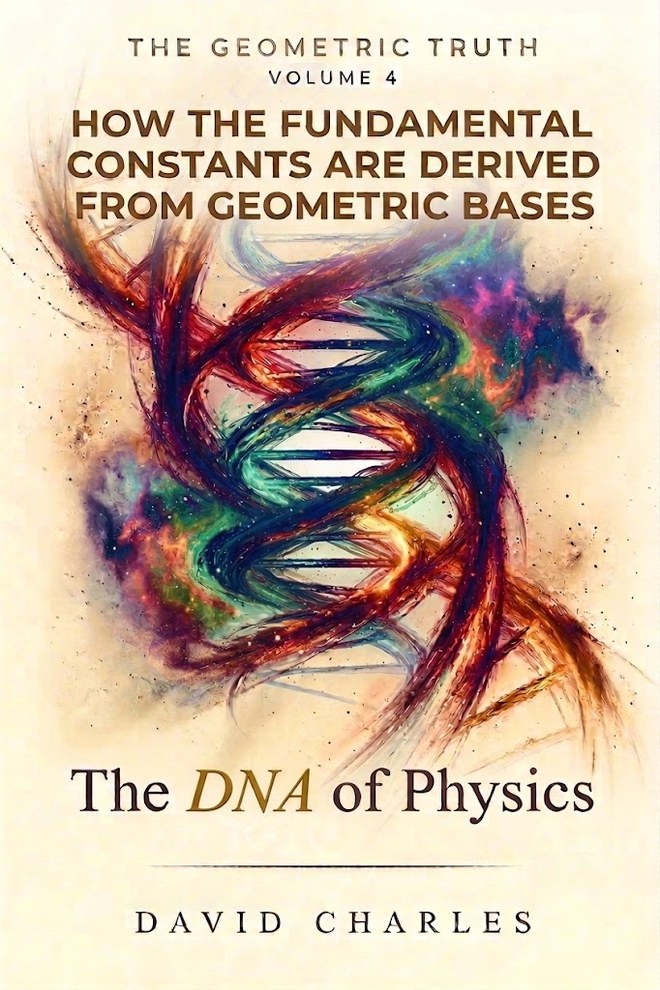
The appearance of many separate universal constants is an illusion. They are one structure — the atom — seen from different directions. This is the argument of Volume IV: the constants are the DNA of physics. The speed of light, Planck’s constant, the gravitational constant, the electron’s mass and charge — every one is a combination of a few quantities the atom already carries.
α = λ̄c / a₀Start with the clearest letter — the fine structure constant
α is the easiest of the constants to see: the reduced Compton wavelength divided by the Bohr radius — the definition of an angle, sitting in the textbooks for a century. Read it that way and the mystery dissolves. It is one letter of the DNA; the rest of the table is built the same way.
The Primitives
Behaviours of the atom.
Take the constants apart and they rest on a small handful of the atom’s own quantities: the Lyman wavelength and the energy that frees the electron from it, the reduced Compton wavelength of the electron — together with pure geometry, the circle, π, and the 360° we cut it into.
These are not a fixed or sacred list. They are behaviours of the hydrogen atom, and there may be more still hidden in it. The number is not the point. The point is that they belong to the atom — and from them, every constant follows.
The Foundations
Every constant, the same few letters.
Everything on this page rests on four quantities — two lengths of the hydrogen atom and two numbers of the circle. From them, one move recurs: a quantity is two faces locked by an invariant — energy × length, time² + space², arc ÷ radius. Here are the cornerstones, in two kinds: what the framework inherits from standard physics and reads as geometry, and what it derives from the four primitives.
λLy
Lyman wavelength
the atom’s boundary length
λ̄c
reduced Compton
the electron’s own length
π
pi
the circle
180
the degree
the 360° we cut the circle into
Standard physics
inherited — the framework’s contribution is the geometric reading
α = λ̄c / a0
α is an angle — arc ÷ radius
ELy · λLy = hc
the two faces of light, locked
δ = LM / r
gravity is an angle · LM = ½ the Schwarzschild radius
Derived in the framework
built from the four primitives
α = 2√(π λ̄c / λLy)
α from the atom’s two wavelengths and π
a0 = ½√(λ̄c λLy / π)
the Bohr radius, from the two wavelengths
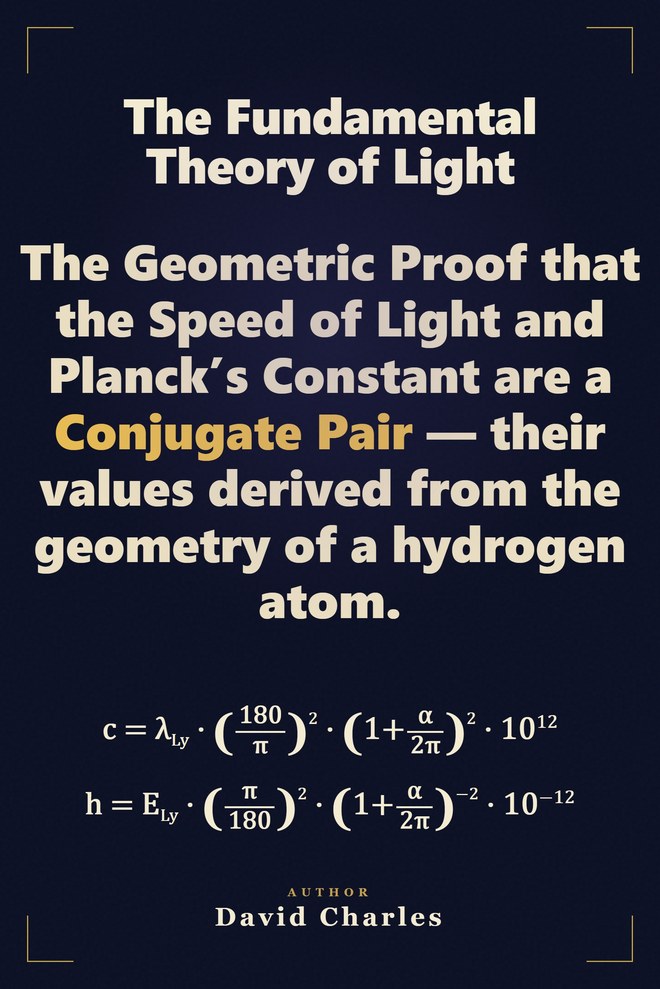
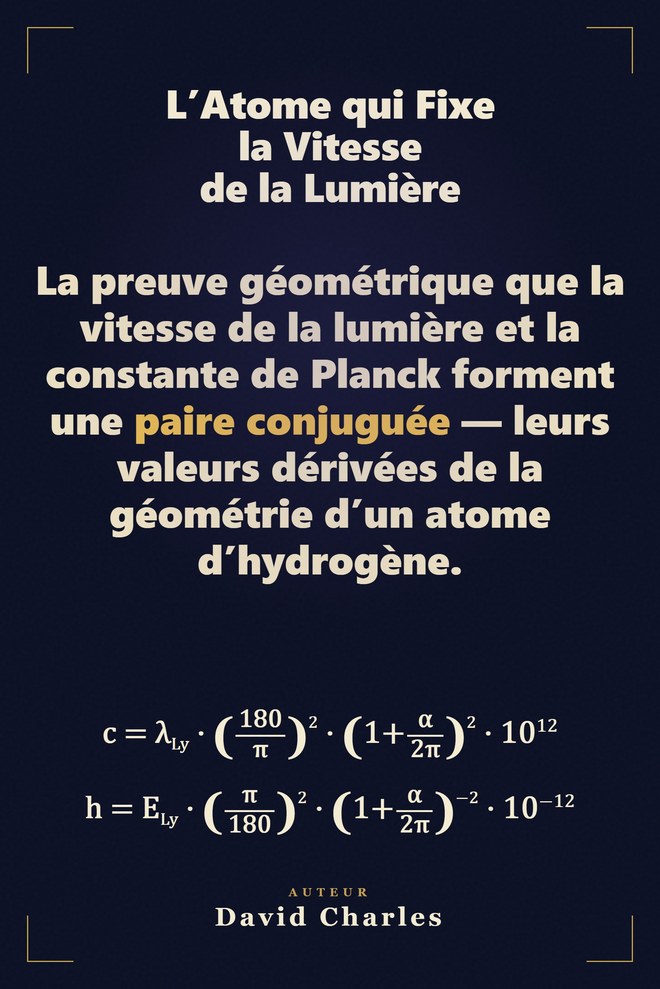
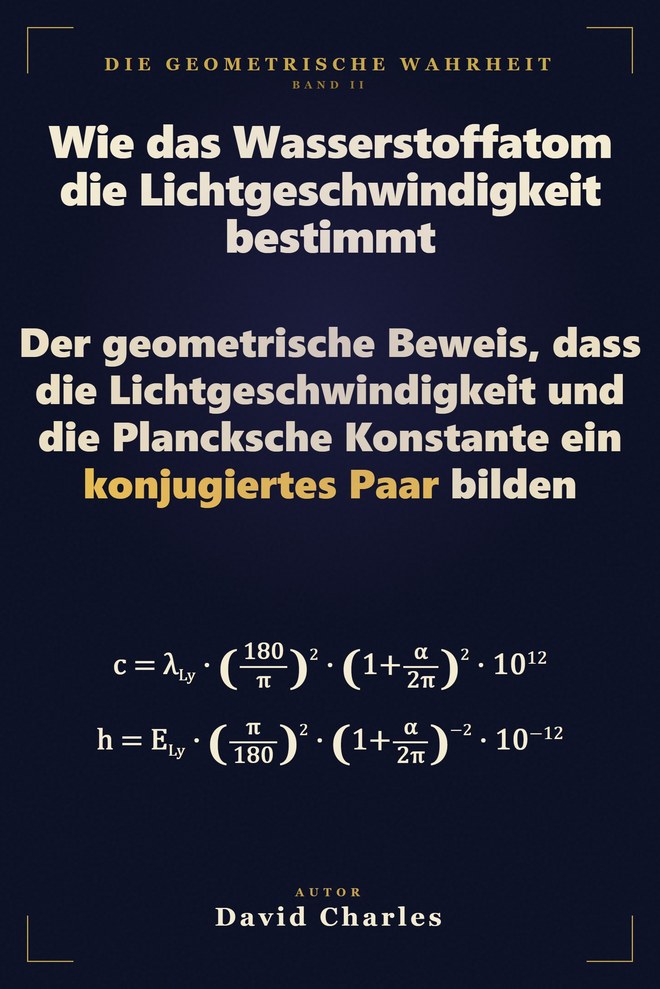
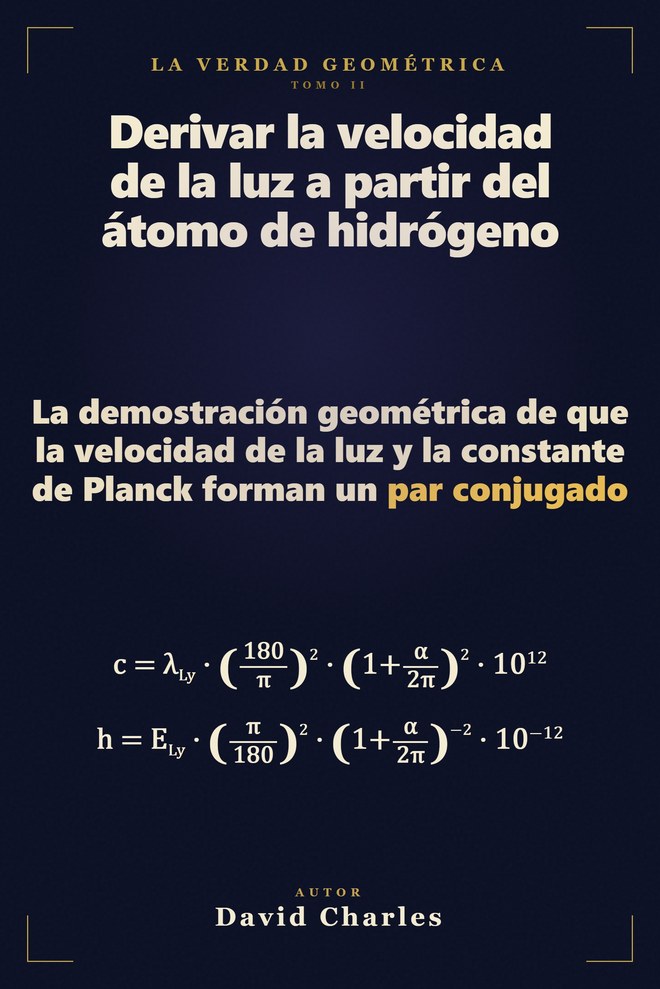
c = λLy(180/π)²(1+α/2π)² × 10¹²
the speed of light
h = (π/180)²(1+α/2π)⁻² × 10⁻¹² ELy†
Planck’s constant
G = (3π/4)(π/180)⁶(1+α/2π)² ‡§
the gravitational constant
These equations give the values the hydrogen atom itself carries. Computed from geometry, c and Planck’s constant each stand 0.018% from the CODATA figures — in opposite, compensating directions — so in their product hc (the two faces of light, ELy·λLy) the offsets cancel and the match is exact. That 0.018% is not an error in the physics; it is the signature of the second — a Babylonian unit of 86,400 to the day, a human convention laid over nature. The atom holds the real numbers; the CODATA values, tied to that inherited second, sit one step removed from it, and the framework reconciles the two to the decimal.
† ELy is not a fifth primitive — it is the energy face of the Lyman wavelength λLy (its reciprocal, conjugate through E·λ = hc). ‡ G is a rung of the constants ladder (from Volume IV), not a standalone derivation. § 3π/4 is a geometric factor, not an arbitrary constant — it is always present when a phenomenon acts equally in all directions throughout three-dimensional space.
Time
Time is not a primitive. It is a count.
Time is not one of the atom’s ingredients — and this is not a guess, it is forced. Velocity is distance divided by time. But the speed of light is at once a distance and a velocity: the same number is both. If distance and velocity are one, the time that would separate them can only equal one.
Time has no dimension of its own. It does not flow — it is a count, nothing more. And the count begins only when the atom lets a photon go: light leaving the atom is what sets it running.
c = distance = velocity∴ time = 1 · a count, not a dimension
How It Is Checked
Nothing asked on trust.
Every step uses standard equations that have sat in the textbooks for a century — the same numbers physics already measures, read a different way.
The Picture They Could Not Draw
See It For Yourself
Of all the constants the atom writes, α is the one you can see. Ask a quantum field theorist to draw what α physically is — they cannot. Here it is; thirty seconds, and you will never see it any other way again. It is the clearest single letter of the DNA — the rest are built the same way.
a₀
The Bohr Radius
5.292 × 10⁻¹¹ m · the orbital radius
λ̄c
Compton Wavelength
3.862 × 10⁻¹³ m · the electron's extent
α
Fine Structure Constant
7.297 × 10⁻³ radians · the angle
The Revelation
The definition of an angle. Nothing more.
An angle in radians is defined as arc length divided by radius. Every schoolchild learns this. It is one of the first things taught about circles.
The electron has an extent — a characteristic quantum length measured by Compton in 1923. Place that extended electron on the Bohr orbit and it occupies an arc of the circle. Divide that arc by the radius of the orbit and you have the angle it subtends.
That angle is α. That is all α is. That is all it has ever been.
And α is only the first letter. The speed of light, Planck’s constant, the gravitational constant — the whole table above — are written from the same handful of atomic quantities. α is simply the one you can draw. That is the DNA of physics.
λ̄cThe electron's extent
÷
a₀The Bohr radius
=
αThe fine structure constant
What Feynman Said
"It has been a mystery ever since it was discovered, and all good theoretical physicists put this number up on their wall and worry about it. We know what kind of a dance to do experimentally to measure this number very accurately, but we don't know what kind of dance to do on the computer to make this number present itself."
He was looking at an angle and seeing a mystery.
What Schwinger Carved on His Tombstone
α / 2πThe anomalous magnetic moment · carved in granite · Los Angeles
When an extended electron completes its orbit it must travel slightly further than 2π radians — it must traverse its own angular extent α as well. The fractional correction to the radius is α/2π. Schwinger derived this from Feynman diagrams. It is the geometry of a circle that does not quite close. He took it to his grave without knowing what it was.
"The physics community spent decades computing corrections to Schwinger's α/2π — pushing precision to twelve decimal places, computing thousands of Feynman diagrams. They were numerically solving a geometry problem. They called it perturbation theory. It was circle-closing."
— The Geometric Truth, Chapter 6
You cannot unsee it now.
The fine structure constant is an angle. The electron has extent. The orbit does not close cleanly. Every atomic calculation for a century has been compensating for this geometric fact without anyone realising it. The full proof — verified to ten significant figures — is in the book.
Verified against CODATA 2018 · 10 significant figures · no free parameters
Stay in the Loop
Join the list.
New proofs, new videos, and word when the next volume lands — straight to your inbox. No spam, ever.
Get in Touch
Leave us a message.
A question, a comment, a correction — the Geometric Truth team reads everything. Leave your email only if you would like a reply; a message alone is welcome.
We will only use your email to reply. Nothing else.
About the Author
David Charles
"I am not a physicist. Perhaps that is why it dawned on me. The trained eye learns what to search for and what to disregard. I had experienced no indoctrination telling me this question was unanswerable."
David Charles lives in Devon, England. He is a retired Chartered Accountant whose career was spent analysing complex systems — implementing them when they worked, diagnosing them when they failed, finding the root cause, and fixing it.
He has turned that same forensic discipline on the foundations of theoretical physics: auditing its most fundamental numbers the way he once audited a set of accounts — asking whether the figures the textbooks treat as separate, measured, and simply given actually reconcile with one another. They do. The first line that would not balance was the fine structure constant, long called one of the deepest mysteries in science, which turned out to be a simple geometric angle hiding in plain sight. Pulling that thread opened the rest of the audit. What began with one constant has grown into a six-volume reconciliation — the speed of light shown to be a distance, Planck's constant, the constants of nature rebuilt from four geometric primitives, and both special and general relativity derived from the same geometry.
He calls it, plainly, the auditing of theoretical physics.
In accountancy, any figure you cannot yet explain is parked in a suspense account — carried on the books, on trust, until you find out what it truly is. The fundamental constants are physics' suspense accounts: measured to exquisite precision, relied upon absolutely, and never explained. David Charles set out to audit them — and found they reconcile. Written in one common language, four geometric primitives, they stop being separate, unexplained givens and balance, every one, against each other. The books balance. His verdict is not a refinement of theoretical physics but a complete reinterpretation of it.
David Charles
My Journey
How a retired accountant found what physicists could not
David Charles first encountered the fine structure constant in a textbook and noticed something that a century of brilliant physicists had overlooked: the defining equation looked exactly like the definition of an angle. Arc length divided by radius. The most elementary relationship in circular geometry.
He spent weeks convinced he had made an error. When you believe you have found a simple answer to a question that defeated Feynman, Pauli, and Schwinger, the overwhelming probability is that you are wrong. He searched the scientific literature exhaustively for the paper that would explain why this interpretation was incorrect.
"My calculation kept working. The numbers kept matching. The geometric picture kept making sense. The anticipated objection never materialised."— David Charles, Preface
That first result was only the beginning. Applying the same audit to the rest of physics' foundations, the reconciliation kept holding: the speed of light turned out to be a distance rather than a speed; Planck's constant, the constants of nature, and both special and general relativity all followed from the same geometry. The mathematics throughout are standard — every equation has been known for a century. What is new is the interpretation: read geometrically, these numbers were never the separate, unexplained givens the textbooks took them for.
The argument is transparent and checkable. The formula requires only a scientific calculator and publicly available data from CODATA. Any reader can verify it in five minutes. David Charles invites them to do so.
✦
Follow the Work
David Charles discusses his ongoing research and responds to questions and challenges about the ideas presented in The Geometric Truth.
The complete Geometric Truth series. Each volume stands alone.
Every volume, one geometry — read in your language.
Available across English · Français · Deutsch · Español · Italiano · Svenska · Nederlands · Português · 日本語 · हिन्दी · العربية.
Choose a volume to see its editions and formats
Volume I
Proof the Fine Structure Constant is an Angle
Paperback · Kindle · Hardback — not yet published
Read it in your language
The Geometric Truth — The Fine Structure Constant
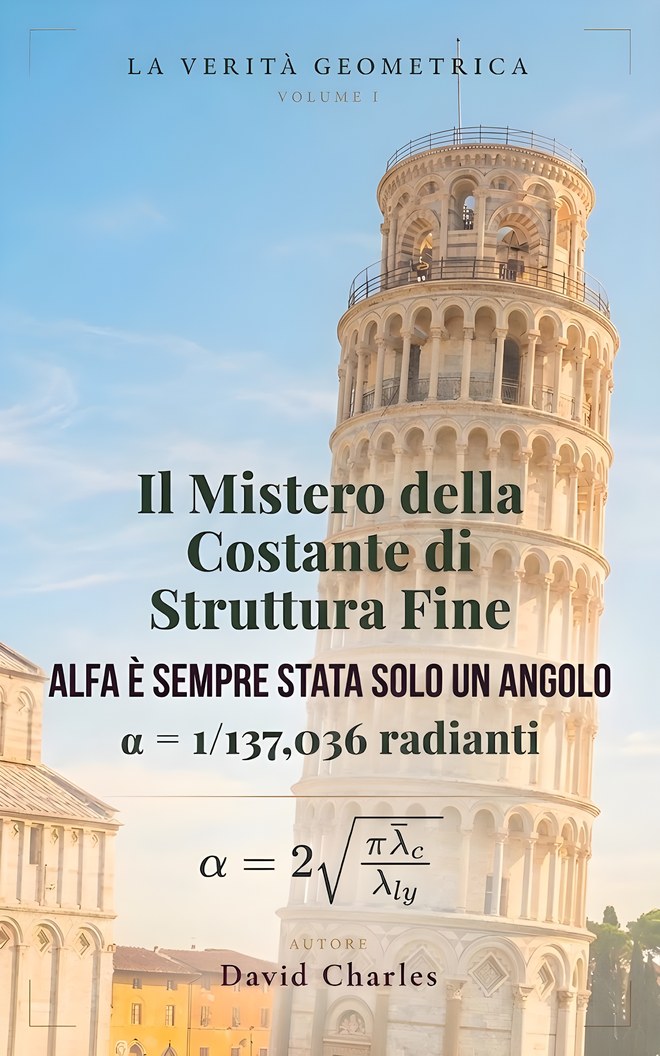
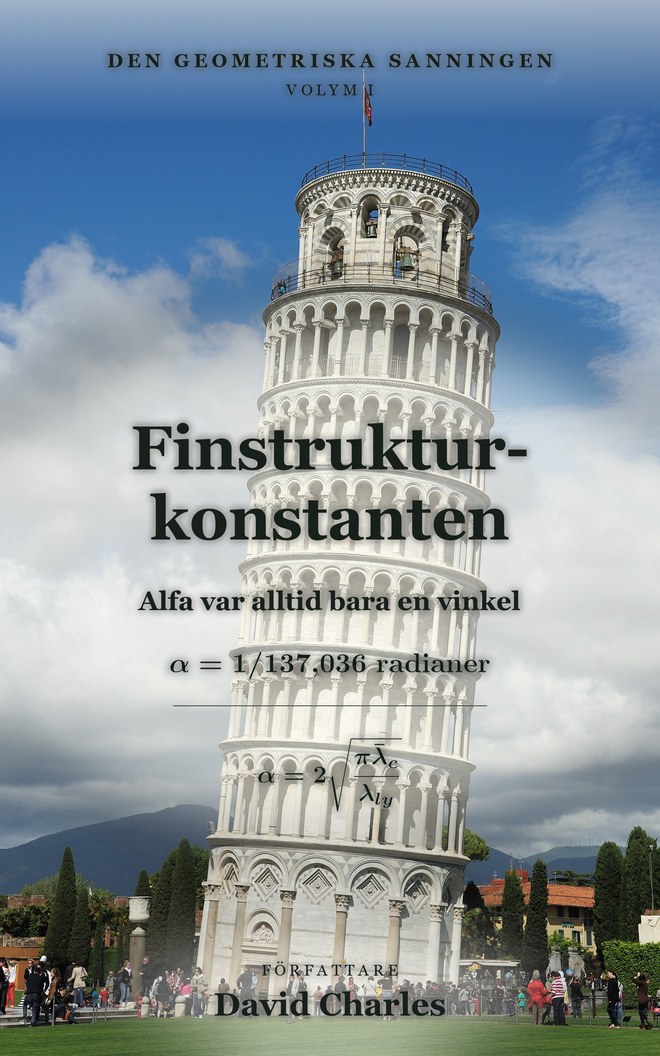
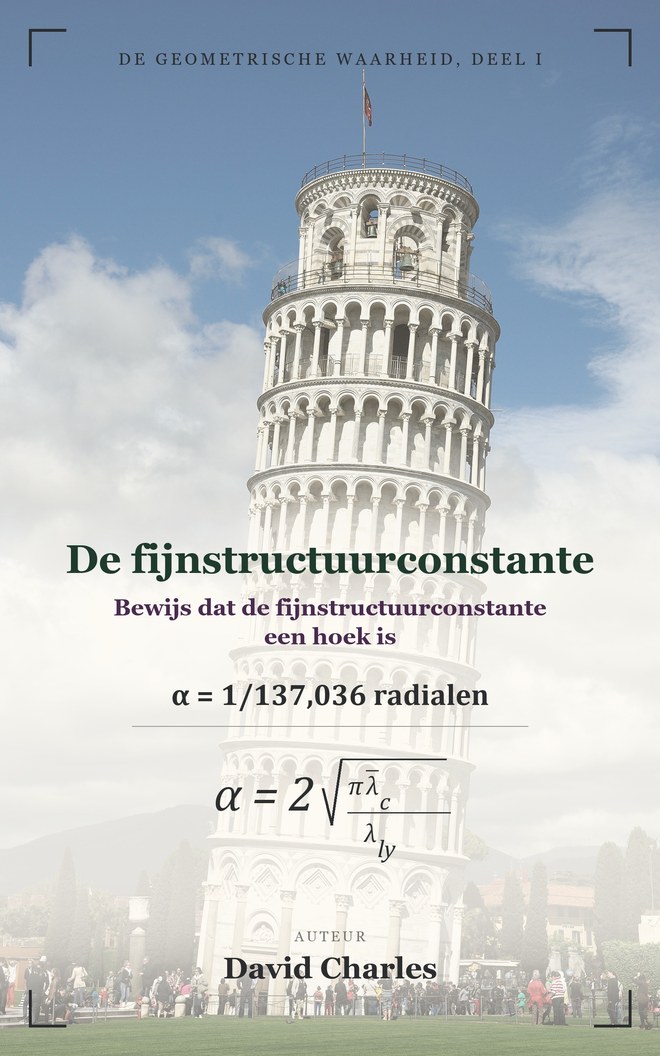
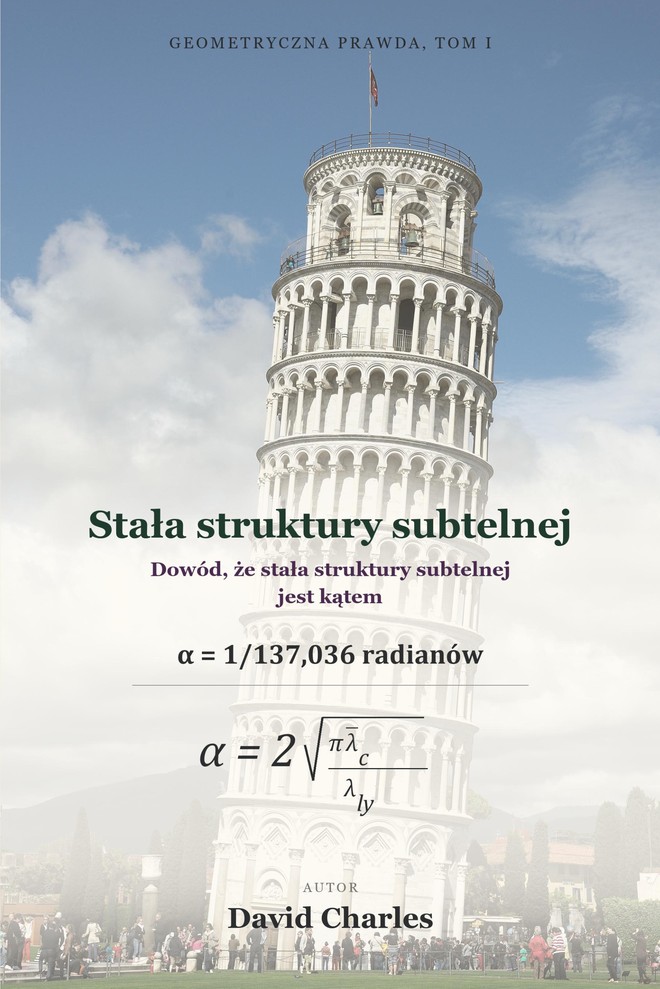
For a century, physicists called the fine structure constant α ≈ 1/137 an unexplained mystery — a number to be measured and slotted into equations by hand. It was never a mystery. It is an angle expressed in radians. Read as arc length over radius, α is simply the reduced Compton wavelength divided by the Bohr radius — and it reproduces the measured value to ten significant figures. Verify it in five minutes with a calculator.
Ein Jahrhundert lang galt die Feinstrukturkonstante α ≈ 1/137 als ungelöstes Rätsel — eine Zahl, die man messen und von Hand in die Gleichungen einsetzen musste. Sie war nie ein Rätsel. Sie ist ein Winkel, ausgedrückt im Bogenmaß. Als Bogenlänge geteilt durch Radius gelesen, ist α einfach die reduzierte Compton-Wellenlänge geteilt durch den Bohr-Radius — und sie reproduziert den gemessenen Wert auf zehn signifikante Stellen. Prüfen Sie es in fünf Minuten mit einem Taschenrechner.
Pendant un siècle, les physiciens ont tenu la constante de structure fine α ≈ 1/137 pour un mystère inexpliqué — un nombre à mesurer et à insérer à la main dans les équations. Ce ne fut jamais un mystère. C’est un angle exprimé en radians. Lue comme la longueur d’arc divisée par le rayon, α n’est autre que la longueur d’onde Compton réduite divisée par le rayon de Bohr — et elle reproduit la valeur mesurée à dix chiffres significatifs. Vérifiez-le en cinq minutes avec une calculatrice.
Durante un siglo, los físicos consideraron la constante de estructura fina α ≈ 1/137 un misterio inexplicado — un número que había que medir e insertar a mano en las ecuaciones. Nunca fue un misterio. Es un ángulo expresado en radianes. Leída como la longitud de arco dividida por el radio, α no es más que la longitud de onda Compton reducida dividida por el radio de Bohr — y reproduce el valor medido con diez cifras significativas. Verifíquelo en cinco minutos con una calculadora.
Per un secolo i fisici hanno considerato la costante di struttura fine α ≈ 1/137 un mistero inspiegato — un numero da misurare e inserire a mano nelle equazioni. Non è mai stato un mistero. È un angolo espresso in radianti. Letta come lunghezza d’arco divisa per il raggio, α è semplicemente la lunghezza d’onda Compton ridotta divisa per il raggio di Bohr — e riproduce il valore misurato con dieci cifre significative. Verificatelo in cinque minuti con una calcolatrice.
I över hundra år kallade fysikerna finstrukturkonstanten α ≈ 1/137 ett oförklarligt mysterium — ett tal att mäta och sätta in för hand i ekvationerna. Det var aldrig ett mysterium. Den är en vinkel, uttryckt i radianer. Läst som båglängd delat med radie är α helt enkelt den reducerade Compton-våglängden delad med Bohr-radien — och den återger det uppmätta värdet till tio värdesiffror. Kontrollera det på fem minuter med en miniräknare.
Meer dan honderd jaar noemden natuurkundigen de fijnstructuurconstante α ≈ 1/137 een onverklaarbaar mysterie — een getal om te meten en met de hand in de vergelijkingen te zetten. Het was nooit een mysterie. Het is een hoek, uitgedrukt in radialen. Gelezen als booglengte gedeeld door straal is α eenvoudig de gereduceerde Compton-golflengte gedeeld door de Bohrstraal — en het geeft de gemeten waarde tot op tien significante cijfers. Controleer het in vijf minuten met een rekenmachine.
Przez całe stulecie fizycy nazywali stałą struktury subtelnej α ≈ 1/137 niewyjaśnioną zagadką — liczbą, którą trzeba zmierzyć i ręcznie wstawić do równań. Nigdy nie była zagadką. Jest kątem wyrażonym w radianach. Odczytana jako długość łuku podzielona przez promień, α to po prostu zredukowana długość fali Comptona podzielona przez promień Bohra — i odtwarza zmierzoną wartość z dokładnością do dziesięciu cyfr znaczących. Sprawdź to w pięć minut za pomocą kalkulatora.
Durante um século, os físicos consideraram a constante de estrutura fina α ≈ 1/137 um mistério inexplicado — um número para medir e inserir à mão nas equações. Nunca foi um mistério. É um ângulo expresso em radianos. Lida como comprimento de arco dividido pelo raio, α é simplesmente o comprimento de onda Compton reduzido dividido pelo raio de Bohr — e reproduz o valor medido com dez algarismos significativos. Verifique-o em cinco minutos com uma calculadora.
طوال قرن، اعتبر الفيزيائيون ثابت البنية الدقيقة α ≈ 1/137 لغزًا غير مُفسَّر — رقمًا يُقاس ويُدرَج يدويًا في المعادلات. لم يكن لغزًا قط. إنه زاوية مُعبَّر عنها بالراديان. إذا قُرئ بوصفه طول القوس مقسومًا على نصف القطر، فإن α ليس سوى طول موجة كومبتون المختزَل مقسومًا على نصف قطر بور — وهو يُعيد إنتاج القيمة المقاسة حتى عشرة أرقام معنوية. تحقّق منه في خمس دقائق بآلة حاسبة.
एक सदी तक भौतिकविदों ने सूक्ष्म संरचना स्थिरांक α ≈ 1/137 को एक अनसुलझा रहस्य माना — एक ऐसी संख्या जिसे मापकर हाथ से समीकरणों में डालना पड़ता था। यह कभी रहस्य था ही नहीं। यह रेडियन में व्यक्त एक कोण है। चाप की लंबाई को त्रिज्या से विभाजित करने के रूप में पढ़ें, तो α केवल न्यूनीकृत कॉम्पटन तरंगदैर्ध्य को बोर त्रिज्या से विभाजित करना है — और यह मापे गए मान को दस सार्थक अंकों तक पुनः उत्पन्न करता है। इसे कैलकुलेटर से पाँच मिनट में जाँच लें।
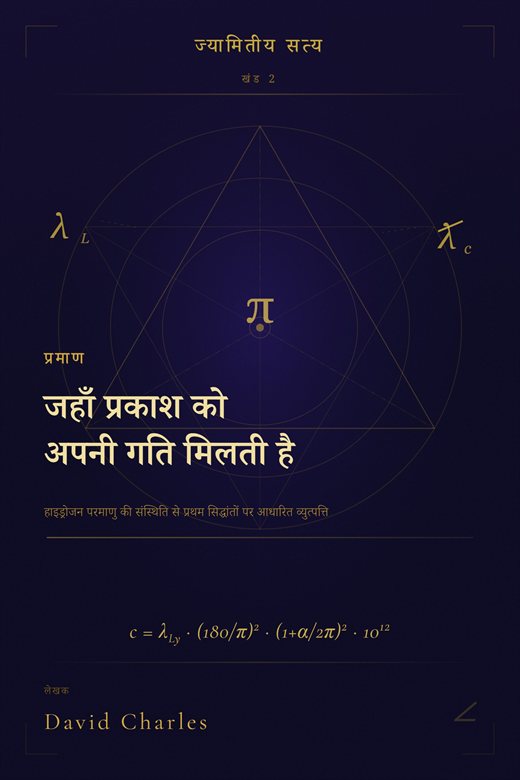
The speed of light is treated as a fundamental constant — a number the universe hands to physics, never explained by it. This book derives it. From the geometry of the hydrogen atom, c emerges as a length — the distance light lays down — not a speed imposed from outside. It is the value the universe itself holds to, read straight from the atom. Verify it in minutes with a calculator.
La vitesse de la lumière est tenue pour une constante fondamentale — un nombre que l’univers remet à la physique, sans jamais l’expliquer. Ce livre la dérive. À partir de la géométrie de l’atome d’hydrogène, c apparaît comme une longueur — la distance que la lumière parcourt — et non comme une vitesse imposée de l’extérieur. C’est la valeur à laquelle l’univers lui-même se tient, lue directement dans l’atome. Vérifiez-la en quelques minutes avec une calculatrice.
Wie das Wasserstoffatom die Lichtgeschwindigkeit bestimmt
Die Lichtgeschwindigkeit gilt als fundamentale Naturkonstante — eine Zahl, die das Universum der Physik übergibt, ohne sie je zu erklären. Dieses Buch leitet sie her. Aus der Geometrie des Wasserstoffatoms geht c als eine Länge hervor — die Strecke, die das Licht zurücklegt — und nicht als eine von außen auferlegte Geschwindigkeit. Es ist der Wert, an den sich das Universum selbst hält, direkt aus dem Atom gelesen. Prüfen Sie ihn in wenigen Minuten mit einem Taschenrechner.
Derivar la velocidad de la luz a partir del átomo de hidrógeno
La velocidad de la luz se considera una constante fundamental — un número que el universo entrega a la física, sin explicarlo jamás. Este libro la deriva. A partir de la geometría del átomo de hidrógeno, c surge como una longitud — la distancia que la luz recorre — y no como una velocidad impuesta desde fuera. Es el valor al que el propio universo se atiene, leído directamente en el átomo. Verifíquela en minutos con una calculadora.
प्रकाश की गति को एक मौलिक स्थिरांक माना जाता है — एक ऐसी संख्या जिसे ब्रह्मांड भौतिकी को सौंपता है, पर कभी समझाता नहीं। यह पुस्तक उसे व्युत्पन्न करती है। हाइड्रोजन परमाणु की ज्यामिति से c एक लंबाई के रूप में उभरती है — वह दूरी जो प्रकाश तय करता है — न कि बाहर से थोपी गई कोई गति। यह वही मान है जिस पर ब्रह्मांड स्वयं टिका है, सीधे परमाणु से पढ़ा गया। इसे कैलकुलेटर से कुछ ही मिनटों में जाँच लें।
For a century, special relativity has stood on a single act of faith — Einstein’s assumption that the speed of light is the same for every observer, however they move. He could never prove it. This book does. Light is not a velocity but a distance, and a distance is the same for everyone; what Einstein had to assume, geometry forces. From one right triangle the rest follows — time dilation, length contraction, and time itself revealed as no primitive of nature. The postulate becomes a theorem.
Comprendre la relativité restreinte par la géométrie
Depuis un siècle, la relativité restreinte repose sur un seul acte de foi — l’hypothèse d’Einstein selon laquelle la vitesse de la lumière est la même pour tout observateur, quel que soit son mouvement. Il n’a jamais pu le prouver. Ce livre le fait. La lumière n’est pas une vitesse mais une distance, et une distance est la même pour tous ; ce qu’Einstein devait supposer, la géométrie l’impose. À partir d’un seul triangle rectangle, le reste suit — dilatation du temps, contraction des longueurs, et le temps lui-même révélé comme nullement un primitif de la nature. Le postulat devient un théorème.
Ein Jahrhundert lang ruhte die spezielle Relativitätstheorie auf einem einzigen Glaubensakt — Einsteins Annahme, dass die Lichtgeschwindigkeit für jeden Beobachter dieselbe ist, wie auch immer er sich bewegt. Beweisen konnte er es nie. Dieses Buch tut es. Licht ist keine Geschwindigkeit, sondern eine Länge, und eine Länge ist für alle gleich; was Einstein annehmen musste, erzwingt die Geometrie. Aus einem einzigen rechtwinkligen Dreieck folgt der Rest — Zeitdilatation, Längenkontraktion, und die Zeit selbst offenbart als kein Grundelement der Natur. Das Postulat wird zum Theorem.
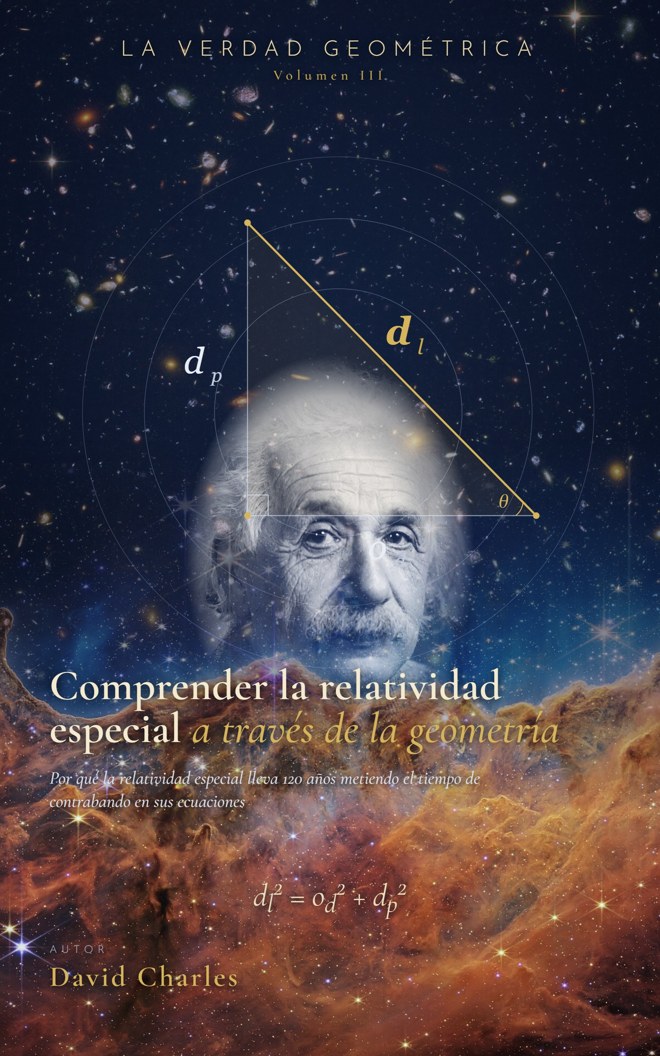
Comprender la relatividad especial a través de la geometría
Durante un siglo, la relatividad especial se ha apoyado en un solo acto de fe: la suposición de Einstein de que la velocidad de la luz es la misma para todo observador, sea cual sea su movimiento. Nunca pudo demostrarlo. Este libro lo hace. La luz no es una velocidad sino una distancia, y una distancia es la misma para todos; lo que Einstein tuvo que suponer, la geometría lo impone. A partir de un solo triángulo rectángulo se sigue el resto —dilatación del tiempo, contracción de las longitudes, y el tiempo mismo revelado como algo que no es primitivo de la naturaleza. El postulado se convierte en teorema.
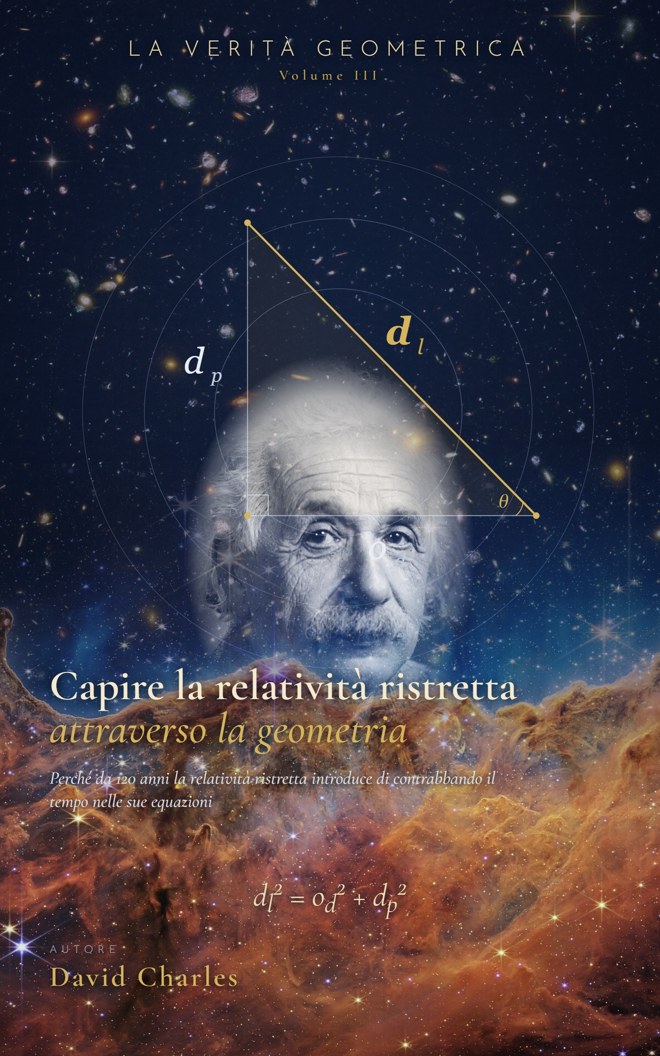
Capire la relatività ristretta attraverso la geometria
Per un secolo la relatività ristretta si è retta su un solo atto di fede: l’assunzione di Einstein che la velocità della luce sia la stessa per ogni osservatore, qualunque sia il suo moto. Non riuscì mai a dimostrarlo. Questo libro lo fa. La luce non è una velocità ma una lunghezza, e una lunghezza è la stessa per tutti; ciò che Einstein dovette supporre, la geometria lo impone. Da un solo triangolo rettangolo segue il resto — dilatazione del tempo, contrazione delle lunghezze, e il tempo stesso rivelato come nient’affatto un primitivo della natura. Il postulato diventa un teorema.
The constants of nature — the electron’s mass, the electric charge, the speed of light, Planck’s constant, the fine structure constant, even the strength of gravity — are treated as independent facts, each measured on its own. They are not independent. A small set of the atom’s own quantities is the DNA from which every one is written. They are not the foundation of physics; they are its output — constructed, not given.
Planck’s constant — the number at the root of all quantum physics, measured for a century but never explained — is one square degree of a circle’s energy, handed over once each turn. That single reading remakes the subject: energy comes in whole packets because the circle parts with one packet per turn, and comes round a whole number of times — so the integers Bohr and Schrödinger postulated are simply the count of whole turns. What was assumed for a century is read straight off a turning circle.
Comprendre la mécanique quantique par la géométrie
La constante de Planck — le nombre à la racine de toute la physique quantique, mesuré depuis un siècle mais jamais expliqué — est un degré carré de l’énergie d’un cercle, cédé une fois à chaque tour. Cette seule lecture refonde la discipline : l’énergie arrive par paquets entiers parce que le cercle en cède un paquet par tour, et fait un nombre entier de tours — de sorte que les entiers que Bohr et Schrödinger ont postulés ne sont que le décompte des tours complets. Ce qu’on a supposé pendant un siècle se lit directement sur un cercle qui tourne.
For three centuries gravity has been a force acting across empty space, or a fabric that bends — never a cause you could picture. This book gives one. Light makes time as it travels; mass slows the making; and things fall toward where time runs slow. No force, no fabric — only the slowing. And the seven classical tests of general relativity — the fall, the bending of starlight, Mercury’s precession, the rest — turn out to be one thing: a single angle, measured seven different ways.
Depuis trois siècles, la gravité est une force qui agit à travers le vide, ou un tissu qui se courbe — jamais une cause que l’on puisse se représenter. Ce livre en donne une. La lumière fabrique le temps en se propageant ; la masse ralentit cette fabrication ; et les corps tombent vers là où le temps s’écoule le plus lentement. Ni force ni tissu — seulement le ralentissement. Et les sept tests classiques de la relativité générale — la chute, la déviation de la lumière des étoiles, la précession de Mercure, et les autres — se révèlent être une seule chose : un unique angle, mesuré de sept façons différentes.
The six technical volumes carry the proof. This second series carries the story — the same geometry, written for anyone who ever wondered where the numbers come from, with the mathematics left in the volumes where it belongs.
The first, Let There Be Light, is published — the rest are listed so you know what is coming, and cannot be ordered until they exist.
A Beautiful Universe · Published
Let There Be Light
Light does something stranger than travel: it makes time. Every clock that has ever ticked was really counting light arriving. Let There Be Light tells where light gets its speed — not a number from nowhere, but a length written into the hydrogen atom — and how time itself begins only when light sets out. It may even answer a question as old as Genesis: why does creation open with light? Because to make light is to make time. Say “let there be light,” and time comes with it. No equations, no jargon — just the idea, told plainly: light came first, and time followed.
Gravity throttles it. The popular telling of Volume VI — why the apple falls, reached without the tensor calculus.
In preparation
A Beautiful Universe
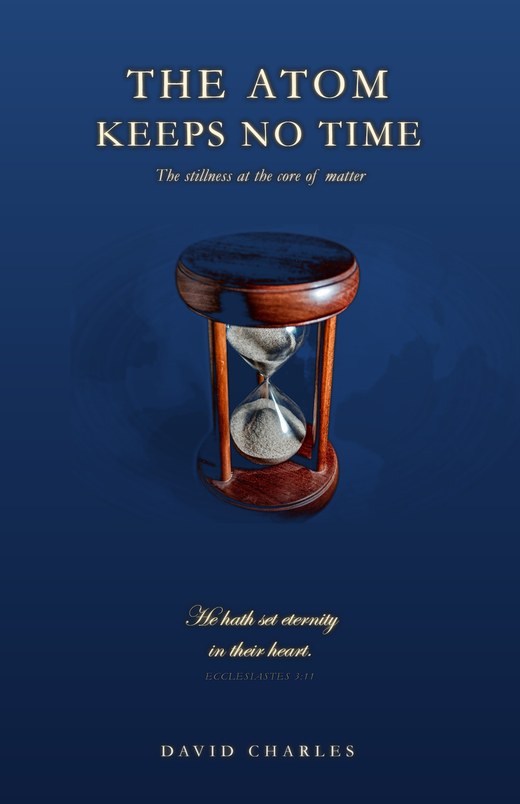
The Atom Keeps No Time
The atom keeps none. The popular telling of Volume V — quantum mechanics from a 360° circle, and an atom with no clock inside it.
In preparation
A Beautiful Universe
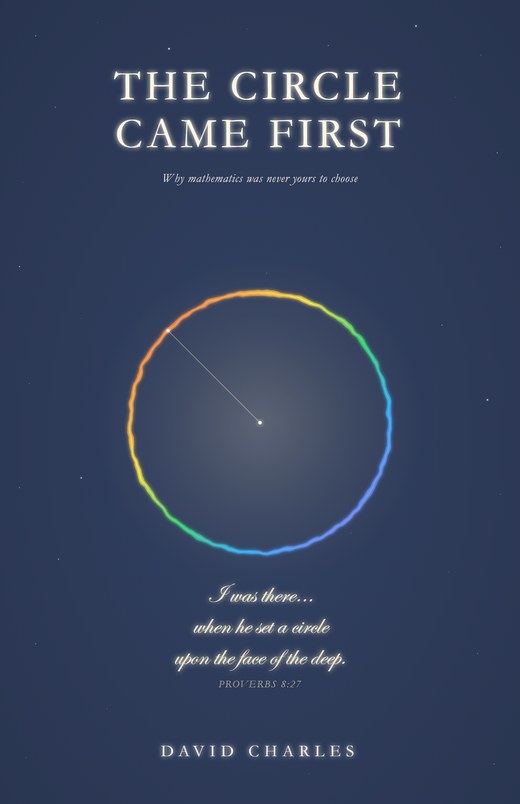
The Circle Came First
Where the numbers come from. The capstone — the four primitives, and the geometry underneath the mathematics itself.
In preparation
A Beautiful Universe
The Flood
Someone once knew. A standalone — the lost world that knew light made time, and built to step outside it.
In preparation
A Beautiful Universe
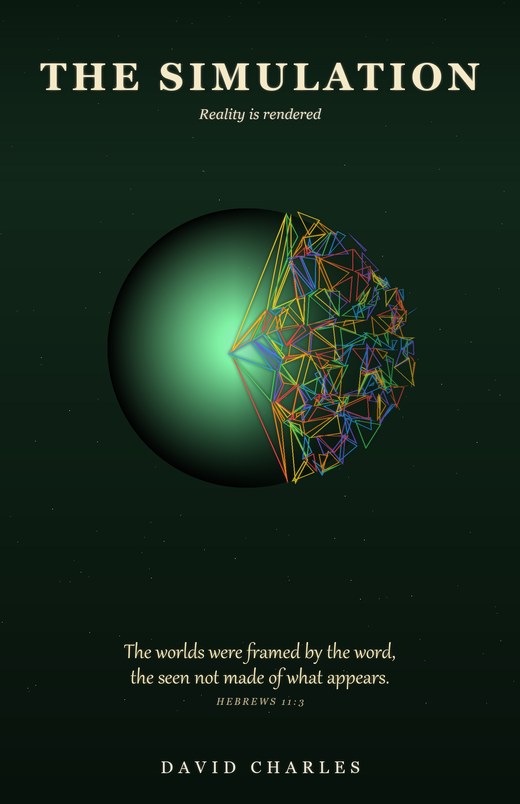
The Simulation
Reality is rendered. The universe looks built the way we build one — a handful of primitives, reused: designed, not evolved.
In preparation
Direct from the author
Digital edition
A direct digital download, straight from the author, is not available at the moment. For now, every volume is available on Amazon — in paperback and on Kindle.
Direct
Volume I — direct digital download
Not available at the moment
Unavailable
Libraries & the trade
Bulk and institutional orders
Libraries, universities, bookshops and distributors: every volume is available for trade and bulk supply, with invoicing rather than card checkout. All editions carry their own ISBN and are listed above. For orders, standing orders, or the complete series, please get in touch.
Purchase orders, standing orders and complete-series enquiries welcome. Invoicing available — no card checkout required.
α
The Source of All Alpha Corrections
The Tombstone Formula
Julian Schwinger carved α/2π on his tombstone. He calculated it through pages of Feynman diagrams and loop integrals. He never knew what it was. It is a circle that does not close.
The Most Famous Calculation in Physics
He got the right answer. He never understood it.
In 1948 Julian Schwinger calculated the anomalous magnetic moment of the electron. Dirac's equation predicted the electron's magnetic strength should equal exactly 2. Experiment showed it was slightly larger. Schwinger explained the discrepancy with a correction factor:
α / 2π≈ 0.00116 · carved in granite · Los Angeles
The agreement with experiment was stunning. It earned him a share of the 1965 Nobel Prize. He requested it be inscribed on his tombstone. When Julian Schwinger died in 1994 they carved it in stone — the crown jewel of quantum electrodynamics, his legacy to physics.
"He calculated it, proved it and took it to his grave. But did he understand what it was?"— The Geometric Truth, Chapter 1
Schwinger derived α/2π from the abstract machinery of quantum field theory. Feynman diagrams. Loop integrals. Renormalisation. The calculation was a tour de force of mathematical physics — pages of formalism producing a number that matched experiment to extraordinary precision.
But the question "what is α/2π?" was never asked. The formalism produced the answer. That was considered sufficient. In the culture of theoretical physics, getting the right number is understanding. It is not.
The Geometry
Two circles. One truth.
A point particle closes its orbit perfectly. An extended electron cannot. The gap between the two circles is what Schwinger spent his career calculating.
Extra circumference ÷ 2π = extra radius · The definition of radius from circumference
The Implications
The source of every alpha correction in physics
α/2π is not merely the correction to the electron's magnetic moment. It is the universal geometric correction that appears whenever an extended electron interacts with anything. It is the fundamental consequence of one simple fact: the electron is too big to fit on its own orbit without making the orbit slightly larger.
Every time α appears in a perturbation series — every loop correction, every vertex factor, every higher order term in QED — it is traceable to this geometry. The circle does not close. Every correction is an attempt to account for that fact.
The QED Perturbation Series
α/2π + terms in α² + terms in α³ + terms in α⁴ + 12,000 Feynman diagrams for α⁵
Physicists called this perturbation theory · It is circle-closing
The series converges because the geometry converges. It has to — because there is a precise fact about how big the electron is relative to its orbit. Each term is a more refined attempt to close the same circle. The calculation was always correct. The understanding was always absent.
"The physics community spent decades and vast resources calculating corrections to Schwinger's α/2π — pushing the precision to twelve decimal places, computing Feynman diagrams with thousands of terms. Entire careers were devoted to pushing this series one term further. It was geometry all along."— The Geometric Truth, Chapter 6
The Institution That Marked Its Own Homework
This is what happens when an institution self-governs and is allowed to mark its own homework. Careers were built on the complexity of perturbation theory. Funding was justified by the difficulty of higher order calculations. Nobel Prizes were awarded for solving what was always a geometry problem.
The tools required to understand α/2π are taught in the first year of secondary school. The problem defeated the greatest physicists of the twentieth century for a hundred years. That is not a tribute to the depth of the problem. It is a measure of how completely an institution can blind itself to a simple truth.
The circle is now closed.
Schwinger's tombstone formula is not a quantum field theory abstraction. It is elementary geometry. The proof is in the book. The numbers are checkable in five minutes. Let them defend.